
Working Dog Field Care & Paw Health
Veterinary-backed field care guide for German Shorthaired Pointers and working dogs: Musher's Secret paw wax protocols, emergency briar laceration triage, and hydration electrolytes.
Working Dog Paw Care & Field Medical Triage Workbench
Veterinary-backed field protocols for pad conditioning, briar laceration prevention, and thermal electrolyte replenishment during upland and wetland hunting.
Apply dense wax 30 min before drop. Carry 1000D Cordura boots for sharp volcanic shale.
Administer 4–6 oz every 45 min. Never allow large cold water gorging.
Balanced sodium/potassium support to prevent post-hunt canine cramping.
Vet-wrap, Celox clotting sponge, sterile saline eyewash for grass awns.
Field Biomechanics: Foot Pad Abrasion & Briar Defense
The foot pads of the German Shorthaired Pointer and Continental versatile pointing breeds are composed of specialized keratinized stratified squamous epithelium supported by a thick digital fat cushion. While naturally resilient, running 15 to 30 miles across rugged upland cover subjects these tissues to severe shear stresses, micro-lacerations from volcanic rocks, and thermal burns from freezing ice crusts.
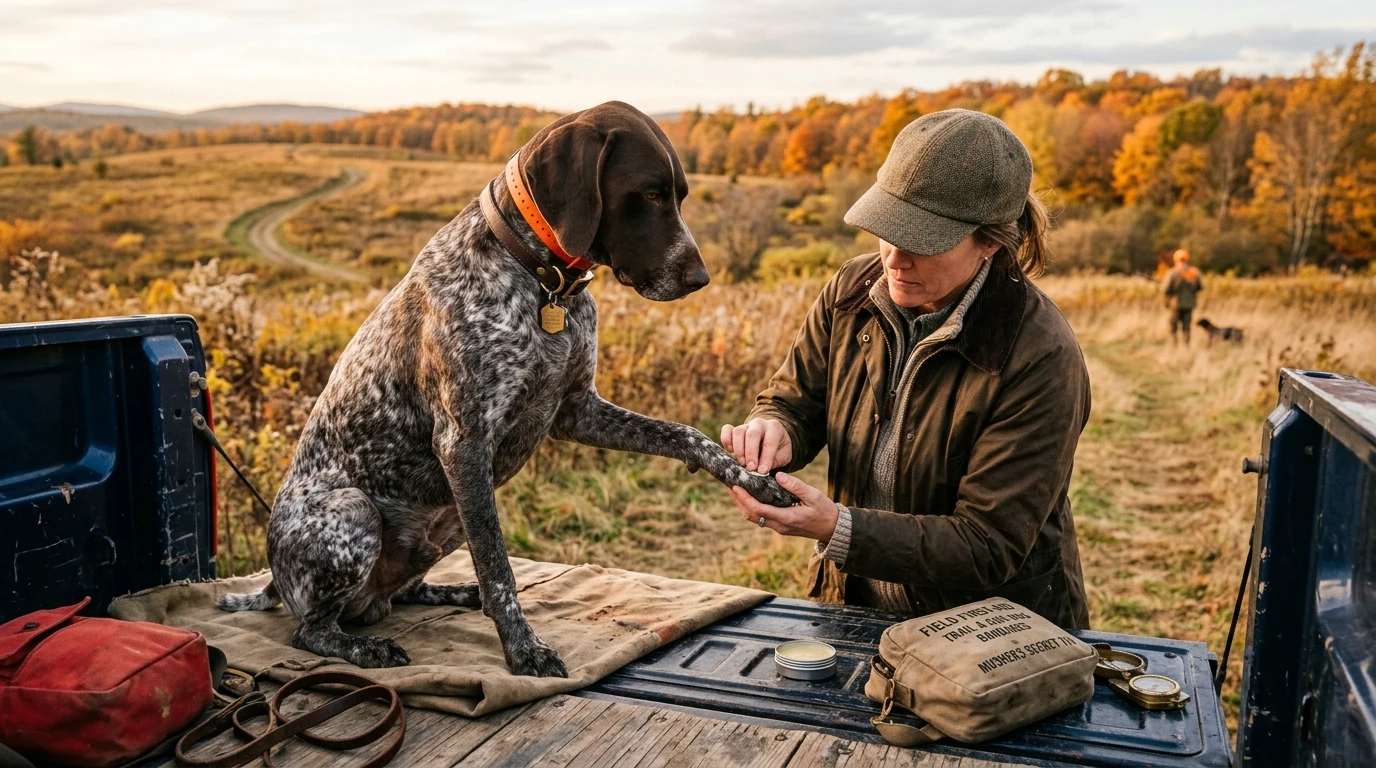
Pad Toughening & Barrier Application
Begin conditioning 21 days before hunting season. Daily application of food-grade beeswax and carnauba wax creates a waterproof, semi-permeable membrane that prevents salt burns and decreases briar penetration without softening natural calluses.
Webbing Inspection & Boot Deployment
Check canine feet every 2 hours during active hunting. Look for interdigital reddening, embedded foxtails, or cracked metatarsal pads. If traveling over sharp shale, deploy Cordura boots immediately to prevent full-thickness pad delamination.
Warm Saline Soak & Antibacterial Care
Rinse all four paws in warm water containing Epsom salts to extract grit and burrs. Treat minor superficial abrasions with veterinarian-approved silver sulfadiazine or antimicrobial hydrogel before allowing the dog to rest.
Canine Field Fluid Requirements & Thermal Dynamics
Unlike human runners who dissipate heat via sweat glands distributed across the epidermis, canines cool primarily through respiratory panting and evaporation from the tongue and nasal turbinates. Under heavy hunting workloads, fluid loss increases exponentially:
Field Canine Hydration & Fluid Replacement Model
Variable Definition & Units
Dog body weight in kilograms (lbs × 0.453592).
Fluid loss rate under rigorous hunting galloping: 14 to 18 mL/kg/hr.
Terrain roughness factor: 1.0 (marsh turf) to 1.8 (volcanic basalt).
Total elapsed active hunting or training time in hours.
A 60 lb (27.2 kg) GSP hunting 4 hours over rugged volcanic hills (k=1.35) at 16 mL/kg/hr: Total fluid loss = 27.2 × 16 × 4 × 1.35 = 2,350 mL. Recommended field administration: 450–500 mL every 45–60 minutes in small, cool volumes.
Emergency Field Lacerations & Grass Awn Extraction Protocols
Working pointers face continuous exposure to hidden barbed wire fences, sharpened beaver stumps, and invasive cheatgrass (Bromus tectorum). When an acute full-thickness laceration occurs in remote cover miles from a vehicle, handlers must immediately stabilize hemorrhagic bleeding before tissue contamination worsens.
Direct arterial pressure applied with sterile gauze or a Celox hemostatic pad stops most capillary bleeding within 3 to 5 minutes. Secure the dressing firmly with self-adhering cohesive wrap, taking care not to occlude venous return. In deep chest or brisket lacerations where skin margins separate widely, veterinary surgical skin staplers provide rapid mechanical closure on the tailgate, shielding underlying pectoral muscles from soil bacteria until formal veterinary wound debridement and drainage can be completed.
Grass awns and foxtails represent an insidious, limb-threatening hazard. Because their barbed awns move unidirectionally forward with every muscle flexion, seeds that penetrate the interdigital webbing quickly migrate up the carpal sheath, forming sterile abscesses that require surgical exploration. Conduct a systematic head-to-paw tactile examination after every hunt, palpating the groin, armpits, ear canals, and under the third eyelid.
Frequently Asked Questions About Gun Dog Field Care
How do I protect my bird dog's foot pads on volcanic basalt and rocky upland cover?
Apply a dense beeswax-based barrier cream like Musher's Secret 2 to 3 weeks prior to opening day to condition pad tissue. On sharp volcanic basalt or sandstone scree, equip front paws with 1000D Cordura hunting boots secured with self-adherent cohesive wrap to prevent debilitating pad shearing.
What items are mandatory in an upland gun dog field first aid kit?
A comprehensive field triage kit must include: Celox or QuickClot hemostatic clotting sponge, 2-inch self-adherent cohesive vet wrap, curved splinter forceps for cactus spines and porcupine quills, sterile eye irrigation saline (for grass seeds), EMT skin glue or surgical skin stapler, liquid diphenhydramine (Benadryl) for anaphylactic wasp stings, and a rectal thermometer.
How do I identify and remove barbed grass awns or cheatgrass from canine paws and ears?
Inspect toe webbing and ear canals immediately after every hunt. Grass awns possess microscopic backward-pointing barbs that migrate inward through the skin, causing severe abscesses and fistulas. Flush ear canals with canine drying wash and use fine forceps to extract seeds before they penetrate the dermis.
What is the immediate field emergency protocol for a deep wire or briar laceration?
Apply direct pressure with a sterile gauze pad. If arterial bleeding occurs, pack with a hemostatic clotting sponge and apply a firm pressure wrap with self-adherent vet wrap. Never tourniquet a canine limb. Transport immediately to an emergency veterinary hospital if lacerations penetrate through muscle fascia.
How much water does an active pointing dog require during a warm early-season hunt?
Working gun dogs lose 15 to 20 mL of fluid per kilogram of body weight per active hour. For a 60-lb (27 kg) GSP on a 4-hour hunt in 70°F weather, this equates to roughly 1,600 to 2,000 mL. Offer 4 to 6 oz every 45 minutes to maintain renal perfusion.