
Backcountry Canine Backpacking & Trail Skills
Master backcountry hiking and wilderness backpacking with pointing dogs: canine pack weight limits (strictly max 15% body weight), water logistics, and trail stamina.
Canine Backcountry Pack Weight & Trail Stamina Calculator
Calibrates ergonomic saddlebag load limits, trail water payloads, and thermal rest intervals adhering to the strict 15% canine body mass ceiling.
Distribute evenly: 3.6 lbs left pannier, 3.6 lbs right pannier.
80–100 mL per mile in mild weather. Carry in bladder flasks.
10–15 min shade stop. Check shoulder harness straps and paw pads.
Includes trail pack resistance factor. Feed high-fat kibble post-hike.
Canine Pack Biomechanics: The 15% Body Mass Threshold
German Shorthaired Pointers possess extraordinary cardiovascular capacity and lean musculoskeletal power, making them ideal backcountry expedition partners. However, canine quadrupeds carry approximately 60% of their dynamic weight on their forelimbs. Misplaced weight or overloaded saddlebags exert immense vertical shearing forces on the carpal joints, shoulder suspensory apparatus, and thoracic vertebrae.
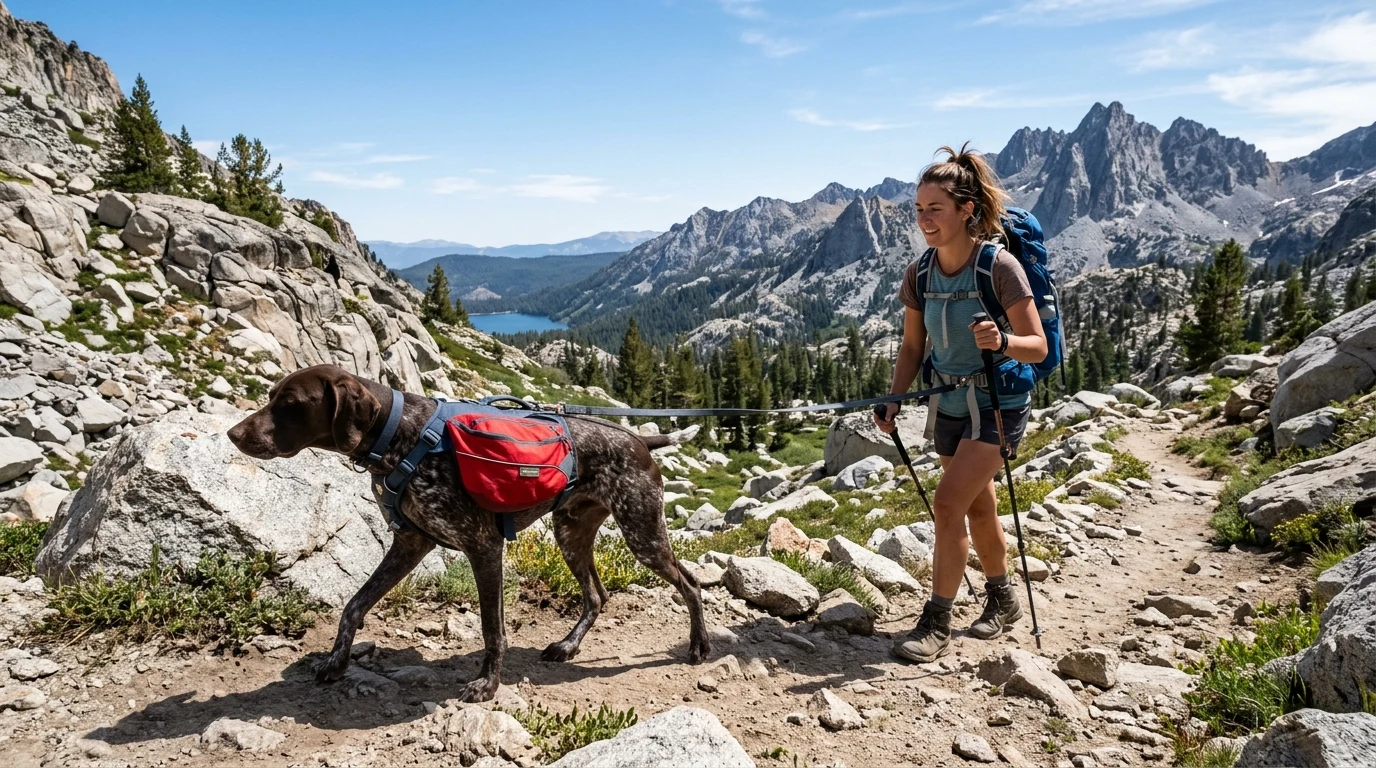
Shoulder Placement vs Lumbar Arch
The deepest part of the pack panniers must ride directly over the dog's ribcage and scapulae. Never allow gear to rest over the weak lumbar spine or flank where the kidneys and lumbar nerve roots are vulnerable to impact concussion.
Calibrated Scale Verification
Always weigh individual panniers on a digital luggage scale before hitting the trailhead. If carrying water bladders on both sides, ensure the dog drinks equally from both sides during trail rests to preserve kinetic center-of-gravity balance.
Sub-75°F Thermal Thresholds
At high alpine elevations (>8,000 ft) or exposed desert routes (like Joshua Tree National Park), high solar radiation combined with dense pack fabrics impairs thermal dissipation. Suspend pack carrying when temperatures exceed 75°F (24°C).
Backcountry Pack Weight & Caloric Resistance Model
Backpack resistance increases canine energetic expenditure by 1.8% per pound carried per mile. Review the orthopedic loading model below:
Canine Ergonomic Pack Load & Trail Burn Equation
Variable Definition & Units
Standard healthy adult canine body weight.
Safe load fraction: 0% (puppy), 0.08 (early conditioning), 0.12 (standard), 0.15 (veterinary max limit).
Daily mileage covered along backcountry trails.
Fluid requirement per trail mile: 80 to 120 mL depending on ambient temperature.
A 60 lb (27.2 kg) adult GSP in prime condition with a conditioning factor of 0.12 on an 8-mile wilderness loop: Maximum safe pack load = 60 × 0.12 = 7.2 lbs (3.6 lbs per pannier). Estimated trail caloric requirement = 1,480 kcal. Water requirement = 8 miles × 100 mL/mile = 800 mL carried on trail.
Joshua Tree & Desert Backcountry Navigation Protocols
Hiking arid wilderness routes such as Joshua Tree National Park, Mojave National Preserve, and high-desert scrub canyons presents unique physiological challenges for working gun dogs. While athletic pointing breeds possess boundless drive, their high motivation frequently overrides internal exhaustion cues, making them susceptible to rapid-onset hyperthermia.
Direct solar irradiance on coarse granite boulders elevates surface temperatures up to 140°F (60°C) when ambient air is only 85°F (29°C). At these temperatures, canine foot pads can suffer second-degree thermal blistering within 10 minutes of exposure. Hike exclusively during twilight dawn hours (05:00 to 09:00), carrying dedicated canine heat boots with Vibram outsoles for rocky desert scrambles.
Carry a minimum of 120 mL of clean water per mile per dog. Because desert potholes and natural tanks harbor dangerous algae blooms, Giardia lamblia, and stagnant agricultural runoff, never allow your dog to drink from standing wilderness pools. Filter all backcountry water through an absolute 0.1-micron hollow-fiber membrane before dispensing into portable collapsible silicone bowls.
Frequently Asked Questions About Canine Backpacking
What is the maximum safe pack weight a German Shorthaired Pointer can carry backpacking?
Veterinary orthopedic guidelines strictly limit total pack weight (including saddlebags, water, food, and gear) to no more than 10% to 12% of healthy body weight for regular conditioning, with an absolute physiological ceiling of 15% for peak adult athletic working dogs. For a 60-lb GSP, this means a total maximum pack weight of 7.2 to 9.0 lbs (115 to 144 oz).
At what age can a young pointing dog begin carrying weight in a backpack?
Dogs should NEVER carry weight in a backpack before 12 to 14 months of age, when distal radial and femoral epiphyseal growth plates have achieved complete radiographic closure. Carrying premature weight risks chronic angular limb deformities and early-onset hip osteoarthritis. Juveniles may wear an empty harness solely for trail acclimation.
How much water must I pack for my dog on arid wilderness trails like Joshua Tree?
In arid, exposed desert environments where natural springs are dry or contaminated with cyanobacteria, pack a minimum of 100 to 120 mL of potable water per mile per canine, plus an emergency reserve. For an 8-mile desert trek with a 60-lb GSP, pack at least 2.5 to 3.0 liters dedicated solely to canine hydration.
How do I balance load distribution in canine saddlebag panniers?
Left and right panniers must weigh within 2 ounces of each other. An uneven load shifts torque across the canine cervical and thoracic spine, causing friction rubs, muscle spasms, and gait abnormalities. Place dense items (water flasks) low and forward over the dog's shoulder blades rather than over the lumbar spine.
What wilderness wildlife precautions are critical when backpacking with bird dogs?
Keep pointers on a hands-free bungee waist leash in high-risk wildlife corridors (bear, cougar, or rattlesnake country). High prey drive can provoke aggressive encounters with moose or porcupines. Outfit the dog with a bear bell, an orange high-visibility harness, and an inReach satellite SOS communicator in remote backcountry.